01The short answer
Plan on a 2 Station washroom trailer for up to about 100 guests and a 3 Station for up to about 150, for an event that runs five to six hours with a bar. Booking both gives you five stations for up to about 250 guests. A party of four hours or less can take more people, and an event that runs all day with drinks needs fewer people per station.
- 2 Station: about 100 guests at a 5–6 hour event with a bar. $1,050 for the event.
- 3 Station: about 150 guests at the same event. $1,200 for the event.
- Both trailers together: about 250 guests.
- The counts start from the PSAI special event chart, add about 20% for alcohol, then round down for the rush after dinner.
- Delivery is $175–$350 depending on location.
02Guest chart by event length
Find the row that matches how long guests will be on site and whether there's a bar. The number in each column is the most guests we'd put on that trailer.
| Event | 2 Station | 3 Station | Both (5 stations) |
|---|---|---|---|
| Up to 4 hours | 150 | 225 | 375 |
| 5–6 hours, no alcohol | 120 | 175 | 300 |
| 5–6 hours with a bar | 100 | 150 | 250 |
| 8+ hours with a bar | 75 | 110 | 185 |
Count everyone who will use the trailer, including the caterer, the band or DJ and any other vendors on site.
03Where the numbers come from
The Portable Sanitation Association International (PSAI), the trade association for the portable restroom industry, publishes a special event chart. It assumes an even mix of men and women, no servicing during the event, and about 200 uses per toilet. Its smallest row is 500 guests, which calls for 5 units at a 4-hour event, 7 at 6 hours and 9 at 8 hours. That works out to about 100 guests per toilet for 4 hours, 70 for 6 hours and 55 for 8 hours.
Each station in a trailer has its own toilet, so we count one station as one unit on the chart. People use the washroom more often when alcohol is served, and planners usually add about 20% to allow for it.
Then we rounded down. The chart spreads use evenly across the event, but at a wedding most guests go at the same few moments: after the ceremony, after dinner and during the speeches. The lower number keeps that line short.
04By guest count
- For 50 guests, a 2 Station covers it, even for a long day with a bar.
- For 100 guests, book a 2 Station for a 5–6 hour wedding with a bar. If the party runs 8 hours or more, take the 3 Station.
- For 150 guests, book a 3 Station for a 5–6 hour wedding with a bar. For an all-day event with drinks, book both trailers.
- For 200 guests, book both trailers. A 3 Station alone only works for a short event of about 4 hours.
- For 250 guests, book both trailers for a 5–6 hour wedding with a bar. For a bigger crowd, or a long day with a bar for more than 185 people, call us before you book.
05Long events and pump-outs
The chart assumes nobody empties the holding tank during the event. That's fine for a one-day wedding. On a multi-day rental, such as a festival weekend or a week on the weekly rate, the tank can fill before pickup.
On the 2 Station, the final pump-out and cleaning after pickup are included, and an extra pump-out during the rental is $150. For a multi-day 3 Station rental, ask us about servicing when you book.
Toilet paper, paper towels and soap are stocked when the trailer arrives. Anything needed after that is yours to bring, so for a long rental keep a spare pack of each on hand.
06Trailers vs porta-potties
We don't rent porta-potties, but if you're comparing the two: a porta-potty is a single plastic stall over a holding tank, usually with no sink or lighting. A washroom trailer has separate stations with flushing toilets, sinks with running water, lights, and heat and air conditioning.
The PSAI chart counts porta-potty units, and we count each trailer station as one unit, so the guest math is the same. For 100 guests at a 6-hour event, that's two porta-potties, or three if the bar runs long, against one 2 Station trailer. Hosts usually choose a trailer for weddings and evening parties, where a sink, lighting and heat make the difference.
07Where to put the trailer
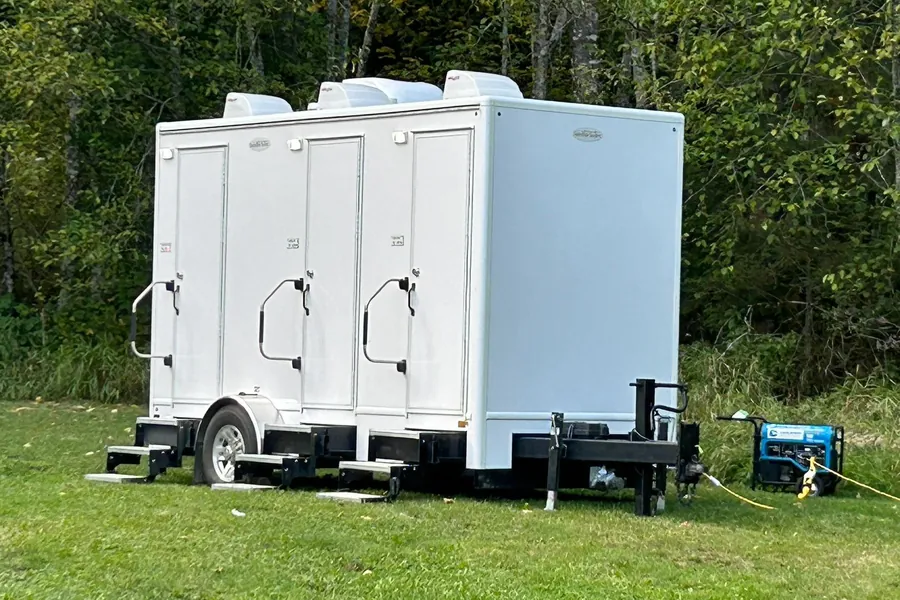
- The 2 Station is about 17 × 8 ft and the 3 Station about 22 × 8 ft. Add room on the door side for the steps, and a clear path for the truck to back the trailer in and pull it out again.
- It needs level ground. Pick the flattest place the truck can reach, such as a driveway, a flat stretch of lawn or a gravel pad.
- It plugs into a 30 A supply or a dedicated 110 V outlet near where it parks. Fresh water comes in the onboard tank, so you don't need a hose.
- Park it close enough to the tent that nobody crosses a dark field in dress shoes, and far enough that the doors aren't beside the head table. A lit path matters more than the exact distance.
- If guests walk across grass to get there, a 10×10 popup tent beside the steps keeps the line dry.
If you're still working out the tent, the tent size calculator gives a size for your guest count, and our tent rentals run from 10×10 popups to a 30×60 marquee. Washroom trailer pages for each city, such as Vancouver, Langley and Surrey, list delivery details for that area.
What the trailers cost, and what changes the total, is in washroom trailer rental cost in Vancouver.